The "Brit a Day" series

What does a months-long parade of attractive British men have to do with fiction, you might well ask? These gentlemen have inspired some lovely scenes, part of the life I live in my head. Over time, some of these scenes reach out to one another and begin to form a story. For the present, each one of these pictures provides a writing prompt for me, a way to keep me writing with a sense of passion and narrative, even when the stories are not yet fully formed.


Sunday, February 15, 2009

The Mathematician Cannot Create Things at Will, part 5

Selina woke up alone one Sunday in December. Graham had left early to prepare for a voice lesson that had been rescheduled from the previous week aand wouldn’t be back until after lunch. She got out of bed and put on the sweatpants that were lying on the floor in front of her. Hearing her roommate Sarah typing in her bedroom, they seemed to be the only two people in the suite, so Selina slid into Sarah’s room and sat on the bed.
“What’s up?” Sarah said as she continued typing.
Selina flopped over on her back. “I think I might be pregnant, Sarah.”
Sarah slid around in her chair and drew one knee up to her chin. “I thought you guys were using something?”
“We are, but… I don’t know.” She grabbed a handful of her sweatshirt and tugged at it, making a tent over her belly.
Sarah shook her head. “Selina, use your brain. You’re not pregnant, you’re just looking for a distraction from the momentous void that’s lying out there waiting for us in six months.” She paused to think and seemed to be sucking on her knee as a child might do absentmindedly for comfort. “Do you and Graham ever talk about what you two are going to do after graduation?”
“No, and it doesn’t matter,” Selina said. She pulled herself upright with a great effort, as though she were already seven or eight months pregnant. “I don’t care what I do. If Graham wants me along, I’ll do whatever he does. I know that sounds horrible, but that’s all I can say. I think he wants to take a year off, maybe get a band together, and then if that doesn’t work out, apply to graduate schools.” Somethng came up from her stomach that soured her mouth. “I don’t know, maybe I made up the part about the band. He doesn’t take it all that seriously. I still want to get a pregnancy test, though. Can I borrow your car to go get one?”
“I think they have them at the drugstore on the corner, don’t they?”
“They’re all out, I already checked,” Selina lied. “Please. I’ll buy you half a tank of gas.”
Sarah shrugged and dug into the pockets of a pair of pants at the foot of her bed. “Don’t park it in a handicapped spot like Joan did, okay?” she said and tossed Selina the keys.
In her room, Selina put on a bra under her sweatshirt and started to change into her jeans. She was looking forward to the chance to drive away from the campus and wondered if she could pick Graham up as he was walking home from the music department. He is so good, she thought. He will deal with this just fine. When they were married, she decided, she would stop wearing old T-shirts to bed and wear nightgowns. She imagined herself in a thin white cotton gown, sheer where it draped over her pregnant belly. Then she remembered what he had said to her at Thanksgiving and muttered to herself, “I can’t believe I’m doing this.”
She didn’t know why she had told Sarah she was pregnant because she knew it wasn’t true. She didn’t know why she was ready to lie to Graham about it, either, because she didn’t believe she needed to be pregnant for him to marry her. It was just that in her dreams she willed herself to be married to him and pregnant with his baby, while in her real life she couldn’t seem to will herself to stop dreaming. The fantasy had become more familiar, and certainly more welcome, than the prospects of her own life, and the details of it were too comforting to give up. She knew, for instance, exactly what their bedroom would be like if they were married. Late at night when she lay with him in her darkened dorm room, she could actually feel her hand skimming the carved bedpost of an antique four-poster bed.
She tried to force herself out of the fantasy by thinking about how absolutely unpregnant she was. She remembered a time when her tenth grade biology class gathered around a lab table to observe a 21-week-old fetus preserved in an enormous jar of formaldehyde. Most of it features were well formed, and she had wondered if it looked like its parents. Her teacher had refused to tell her where it had come from. If she ever thought she was having a miscarriage, she knew she would be sickened to death by the memory of what she’d seen in the jar. She would be lying on their cool bathroom tile with her head on Graham’s knees, listening to his breathing heavy and irregular because he would be crying, thinking of the jar and knowing that there was nothing she could do to keep the fetus inside her. He would squeeze her hand and say, “What can I do? What do you want me to do?”
Why don’t you just shoot me, she thought. You said it: I’m too intelligent to be doing this. She dropped the car keys on the floor and fell back on her bed.

Sunday, February 8, 2009

The Mathematician Cannot Create Things at Will, part 4


They stayed on campus together over the week school was out for the Thanksgiving holiday. Their roommates were all gone, and they lived together in his dorm suite, making love every morning, afternoon, and night in his bed. They ate out breakfast and lunch, but in the evenings they let themselves into the student kitchen in the basement of the dorm to make dinner. Because the basement was so eerily quiet, they felt like they were going to a bomb shelter, and Graham started bringing a radio to keep them company. He caught up on reading from his Milton and Frost classes as Selina fixed their meals, turning down the radio sometimes to ask if she needed his help. They ate just one meal on Thanksgiving Day, some sliced turkey they bought at a deli the day before and a loaf pan of instant boxed stuffing that Selina garnished with canned cashews. While they were in the kitchen that day they made love twice, one time with her sitting on the counter and the other as she straddled him on a chair, her bare legs warmed by the oven as it was browning the pan of stuffing. With Graham’s approval, she kept on a stained terrycloth apron she had found in the basement as she imagined some young housewife would wear it, using it to coyly cover their sex.
On Sunday night before classes resumed, he sensed something was wrong as she took some biscuits out of the oven, and he stood and held her while their dinner got cold on the plates someone had pilfered from the dining hall. She crushed the fabric of his shirt in her fist and pressed it to her nose. "I loved this week. I could do this Suzy Homemaker thing with you for a long time, Graham, and I honestly believe that’s all it would take for me to be happy."
"Don’t say that," he said quietly. She felt is unshaven cheek moving against her hair as he spoke. "You’re too intelligent to believe something like that."


Tuesday, February 3, 2009

and the greatest of these is love


Bruce Springsteen is one of my heroes. I have loved him—NOT too strong a word—since I first heard “The Meeting Across the River” in 1975. He recently said in an interview with Rolling Stone, about being a 16-year-old kid in a band, “I was very isolated. That’s a common story with rock musicians. We all feel like that. And it makes you mad…..I mean, REALLY mad! But if you learn to organize your desires and demands and shoot them into something that is more than just being about you, you start to communicate. I wanted to be a part of the world around me.”

He went on to say about his writing, “I will steal directly from life…things everyone goes through. I’m not interested in the solipsistic approach to songwriting. I don’t want to tell you all about me. I want to tell you about you.”

Back in April, five nights after Danny Federici (his bandmate of more than 40 years) died of melanoma, the interview says, “Springsteen opened his show in Tampa, Florida, with a film tribute to his old friend and a version of ‘Backstreets’ without organ—and a spotlight shining where Federici should have been. ‘That was Bruce’s way of saying, “OK, everyone is wondering about our loss,”’says (bandmate Nils) Lofgren. ‘“Well,let me show you how bad it is.”’

Upon the death of a friend, looking into the face of one’s own mortality, mortality sometimes seems to smile back. “It’s a funny thing to say. But I’ve got a deadline! And that fire I feel in myself and the band….It carries an element of desperateness. It also carries an element of thankfulness….We are perched at a place where we want to continue on—with excellence,” Springsteen then said. “That’s our goal. All the rest of the stuff—we’re gonna figure it out.”

Thursday, January 29, 2009

The Mathematician Cannot Create Things at Will, part 3


She had tried to explain it to her mother in the phone call they’d had the night she’d met Graham. But her mother had misinterpreted what Selina was describing to be some hormonal thing.
“Could it be from what they call ‘pheromones’ these days?” her mother said. “You have so many roommates. Or maybe it’s something you inherited from me. I’ve always been consumed with dread, but my doctor says I need more exercise.”
Selina had then groaned and said, “Hey, Mom, are you trying to tell me that I can’t concentrate on choosing a career path right now because my body is making me so crazy that I can’t think straight?”
“It’s something to consider,” her mother said. “When I was your age, all I could think about was getting married and having babies. That was my only career path.”
“Funny,” Graham said in response to what Selina had just been saying. “Teaching’s the one thing I think I would really like to do. A full professorship in literature with tenure would be nice someday. But if it never happened, I’d always have rock and roll to fall back on, wouldn’t you think?”
“Yeah,” she sighed. “Sounds like graduate school for you.” She tossed the rest of the uneaten crust onto the empty pizza pan. “Unless you just like to perform in front of crowds. In that case, you really ought to just stick with the guitar.”
After dinner, as they walked past the building that housed the inelegant biology department, they ran out of things to say again, and Graham leaned over to give her the entry for the heading First Kiss.
The First ‘I Love You’ came not so much as a murmur but as more of a projectile after she pleaded with him, kissing him on her bed, “Graham, just say it. I know you want to, and if you say it, I can say it, too.” He said it, possibly with more conviction than he had meant to, and she raised up over him as he was washed down onto his back with the torrent of emotion that poured out around him. “God, look at what you’ve done to me, Selina,” he said looking up at her. It was one o’clock in the morning, and everything he said came out in a hoarse, almost falsetto, whisper. “I’m in love with you. I don’t ever want to leave you, I want to be with you for as long as I can.”
Of course, Selina had one other heading on her blackboard that had been discreetly left out of the bride’s book. It was called First Time We Made Love. “Let me touch you down here,” Graham said one night as his hand moved lightly over her hip. They were both naked from the waist up, lying with her back to his front like two spoons in a silverware drawer, and as he whispered to her his fingers traced along the top band of her panties. “Just with my hand. I want to make you come.” She arched her back and dropped her shoulder onto his chest. Then she reached down to guide his hand until he had the rhythm she wanted. In a few minutes, she finished pushing his underwear off with her foot and sat on top of him, feeling his fingers lace together in the small of her back as she tucked him inside of herself. For some reason, she began thinking words in her mother’s voice. Before she knew it, she was close to whispering in his ear, Oh God, Graham, I want your baby. At that moment, getting pregnant was an impossibility since she was on the pill, but still she begged God, please get me pregnant, please let him be the father of my baby. She could have gone on like that for hours, but she knew that he was probably wishing that she would come.
After they had sex, her anxiety about graduation disappeared for a while, and for the first time, she welcomed her own thoughts about the future, even coaxed along little visions in her imagination of what their life together would be like. She saw them traveling a great deal, touring with Graham’s rock band once he became famous, their baby or small child constantly beside them. Everytime she thought of the baby boy they would have, she liked to imagine what it would feel like to nurse him. Graham would be there, helping her keep her long hair out of the baby’s face as he drew up close to her breast, just as she would keep Graham’s hair out of his hands and mouth afterward when Graham cuddled their son.
When ever they both had reading to do, they saved it for the last thing before going to sleep so they could crawl into bed together and read in each other’s arms. On this particular night, Light in August was resting just below the hollow of her neck, propped open in his hand.
“Graham, I’m going to sleep,” she said, studying the ceiling. She had been re-reading Frege’s Foundations of Arithmetic, and she was dead tired.
“Mmm… okay, I’m almost done,” he said. He moved his eyes from the page just long enough to give her a light peck on the cheek.
She closed her eyes and let her thoughts go wherever they wanted to. Even the mathematician cannot create things at will, Frege said. He can only discover what is there and give it a name. When she imagined these scenes from her future with Graham, she felt like she was discovering all the possible pathways from which she would choose one to be her life. This is why I came to this school, she decided. My fate, to meet Graham. So much for “How We Met and Married,” she thought. Most of the blackboard was already full.
Tonight, she imagined that someday they would be on an airplane, the lights lowered for night and the air conditioning turned up to make the hypnotic white noise that would induce everyone on the plane to sleep. They would sit with their son, four years old in this episode of her fantasy, in the seat between them. Graham’s hair would spread like a silk shawl over his shoulder, and she would let her eye drift down his arm to his wedding ring, his hand resting on the hip of their small son, asleep and nestled at his father’s side. The image made her ache. She rolled toward him and started to bring her knees up to her chest, but there was no room left between them in the twin bed. It’s just so simple, Graham, she thought. It’s so beautiful and elegant and simple that it hurts.
“Okay, I know, I know,” he said laughing. ‘I take the hint and I’m putting down the book.” Her knees were digging into his hip. He tossed the paperback onto her desk and turned out the light.

to be continued.

Sunday, January 25, 2009

The Mathematician Cannot Create Things at Will, part 2


Every step along the course of romance boiled down to a line in a book Selina had once seen years ago. The book was a bridal shower gift to her cousin, an album to be filled in as a keepsake by the bride, and the page that had caught Selina’s eye was headed “Our Courtship: How We Met and Married.” The subheadings, First Date, First Kiss, First Murmured ‘I Love You’, were all etched in her head on what she envisioned as a large blackboard, with fist-sized smudges of chalk beneath each phrase from her earlier erasures. Her First Date with the guy from across the hall (his name was Graham) was the dinner he bought her the following weekend at an ivy-covered pizza parlor where she felt so at home she could have camped out in one of its booths.
When Selina had gone back into the hall that first evening after calling her mother, his door was still open. She saw him through the doorway sitting with his back to her on an old couch that sagged under his weight. Some of his hair, which she could see now was more of a chestnut color, was tossed over the ragged back of the couch, and he was reading from a book propped open on one knee.
“Could I come in?” she asked from the hall.
“Please do,” he said turning slightly to her. “My name is Graham, by the way.” He leaned forward a little, like he was going to stand up, and she shifter her weight onto the balls of her feet.
“Oh, yes. Hi. I’m Selina.” His face was still white and smooth, even in the better light. He was wearing jeans and a button-down shirt made of faded blue ticking that reminded her of an old feather pillow. He was holding a worn paperback copy of The Wasteland and Other Poems upside-down in the hand that was dangling over his knee while he looked at her, patiently waiting for her to step into his room.
Three days later, they had finished eating and pushed their plates to the side when, during the first inevitable awkward pause in their conversation, she found him looking at her like that again. Then Graham slid his hand across the table to barely touch the tip of her left middle finger, and he asked her about the two thin silver rings she wore on that hand. One had been given to her by her grandmother, she said, and the other she had bought for herself. She studied the calloused ends of his fingers.
“Do you ever sing, too, or do you just play the guitar?” she asked. His hand was still half an inch from hers.
He seemed mildly embarrassed. “You know, since I waited that day for all of my roommates to leave, I stupidly pictured myself playing in complete privacy. But I guess the whole dorm must have heard me.” He smiled down at the table and said, “I do sing, but never in the room. Not even if I think I’m there alone.” He looked over to see how amusing she found the whole thing. Selina smiled back. Her fingers, which she hadn’t moved in several minutes, had gone numb. “I take voice lessons from time to time in the music department, so I have access to the practice rooms. They’ve started to frown on anyone accompanying himself on the electric guitar in there, though.”
“I guess using the shower for that would be out of the question, then,” she said. He laughed and she leaned forward to examine her own hand, still laid flat on the table.
“But seriously, do you think you’ll do anything with it? Professionally, I mean. I thought you sounded pretty good.”
“Oh, I don’t know. Hopefully, I’m not dumb enough to try. Hopefully.” He leaned back against the seat. “What about you? What are you planning to do with your philosophy degree?”
“Mathematical philosophy degree,” she corrected him. “My senior essay has to be approved by both departments.” She pulled her plate back in front of her and began breaking off pieces of leftover pizza crust. “Well… I’ve considered law school, but I’m not really that kind of person. You know… Driven and ambitious.”
He drew his head toward the back of the booth. “Writing a math paper must be very strange,” he said.
“It’s more about logic than math, really,” she said. “My papers are always very short, just a couple of pages. A good, tight proof in logic is described as ‘elegant.’ Isn’t that a lovely expression? You could never say tat anything about history or biology was elegant.”
“I suppose not,” he laughed. He pulled back his hand slowly to the edge of the table and let it drop into his lap.
She popped a piece of crust in her mouth and spoke around it. “I know one thing though. I don’t think I’d make a very good college professor, which would be the other way to go. Speaking in front of crowds makes me extremely nervous.” Usually, Selina avoided conversations about anything post-graduation. When she thought about leaving college, she felt a physical pressure from the inside pushing out, as though there were a quantity of blood in her greater than the capacity of her veins and arteries, and she was afraid that before long she would explode.

Thursday, January 22, 2009

The Mathematician Cannot Create Things at Will, part 1

Selina recognized the onset of sleep as the intermittent deafness she was experiencing. For example, she could no longer hear the guy playing his excessively loud electric guitar in the dorm suite across the hall, but she could still feel the vibration of it. She could see her room turn to fuzzy pixels of gray light and then to nothing.
Sometime later she woke up, and the sound of the guitar penetrated her foggy head again. The only light in the room was that of a street lamp that had come on outside her window while she was asleep. She picked up the telephone and untangled its extra-long cord until she could reach the hallway with it because she intended to use it as a prop.
She rapped hard on his door with her knuckles which stung them badly, but she didn’t want to announce herself with the usual pounding of fists. She wanted to be kinder than the time she’d complained about the stereo because since she’d complained the guys were playing it louder than ever. The guitar stopped abruptly, and she heard three quick steps before the door opened into the other room with such force that a little of her hair was sucked forward onto her face.
"Yes?" he said. He was not the one she had expected. She knew three of the guys who lived there by sight, although she had only met the one who consistently played the stereo at top volume at 2:15 every afternoon, one of her favorite nap times. But she had never seen this one before. His face was soft and pale, framed by dark straight hair trimmed bluntly below the shoulders. Looking into the poorly lit hallway made his eyes large. That is a wonderful face, she thought, and I’m standing here in the fluorescent light with creases on my cheek from the couch cushions.
Selina had the base of the phone in one hand and the receiver in the other. "I’m really sorry to bother you," she said, sounding politely rehearsed, "But I’ve got to call my mother, and with you playing so loud, I can’t even hear the dial tone."
That was how they met. That was how Selina, in the middle of what should have been her pre-professional senior year panic, was able to carry herself serenely for a few months above the ocean of dread that would have otherwise drowned her. For that brief, sweet time, she kept herself in purposeful denial of the corporate recruiters who were already raiding the campus, of what her roommates wore to their job interviews, of flyers and table tents announcing career seminars. During that time, she never once considered typing her resume. All because she met a guy. That and the fact that she could sleep through almost anything, even the most oppressive anxiety.

Monday, January 5, 2009

Of Oatmeal and Che

I dreamed the other night that Che Guevara was coming to my house for dinner. It was a very large house, and it was a very large dinner party. I knew that Che was not going to be there for very long because he was very, very old. So I had my eye out for him because I wanted to ask him how he liked Benecio del Toro in the movie.

Just as he was about to arrive, one of my guests—never seen him before--said he was dying for some oatmeal…literally, dying. There have been some comments in the past, internally among my household, that I am not the most accomplished of hostesses, so I couldn’t just blow the guy off. I knew I had some instant oatmeal in my kitchen, but you know what? When I got there it was my parents’ kitchen, and it was enormous. It was rooms long, filled with dark, disorganized cupboards, and the cupboards were filled with old, mislabeled food. I kept finding stuff that looked like it could be instant oatmeal—no, that one was drain cleaner. I could try cooking this other one, but it might not be food. One way or another, it looked like that guy was out of luck.

Now Che was arriving, but I was stuck in the kitchen trying to make oatmeal for the guy who was dying—by now, he was lying nearly unconscious across the laps of several other dinner guests. All I had been able to find was old fashioned oatmeal. It had to be fully cooked. Che Guevara left, and I never got to meet him. I have no memory of the fate of my dying guest.

I hope Benecio del Toro is good in the movie.

Wednesday, December 31, 2008

M.I.A.

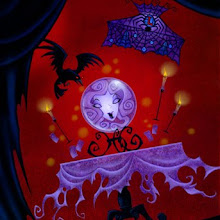
I've been away from the blog for almost 2 months now which is a shame because it seems like I don't read my friends blogs unless I'm keeping up my end of things. I've been really busy prepping for a show at Diversionary Theatre here in San Diego, "As Much As You Can," for which I am designing the set. I created the image you see above (well, actually I adapted it, but you'd never recognize the original) as a possible set piece--it sort of sums up the complexity of a family--a family tree with so many twists and branches that the birds who nest there look as though they can't find one another. I'm neither disappointed nor relieved that this image will not be appearing on the stage--no, I take that back; I was relieved when the director had a clear enough vision of the play to ask me what we were asking the audience to believe this piece was. Was it a painting, or a tree? What did it have to do with the sort of iconic family/life vignettes we had created otherwise? We decided we didn't want to go there. But we both have seen the image of the tree now, if you know what I mean. We shared it, so it wasn't wasted.
There seem to be three legs to my milking stool of a life, and I can almost always keep my balance if I have two of them. They are: Designing (with a heavy dose of collaboration), Walking my solitary urban hiking trails that I've devised to keep my sanity, and Producing written language worthy of even one reader. I love doing all of these without passing through the conventional tollbooths of job interviews, walking buddies, and editors.

Tuesday, November 11, 2008

The Man Who Makes Her Say Things, part 4

The three of them made small talk about Ricky Ford’s latest movie, and Dave recalled specific examples of stupid directors and producers with the undisguised contempt that a person can have for unpleasant things when he has escaped daily contact with them. But the nice thing about Dave Bridges was that nobody around him had to say anything at all. Not long after Evelyn slid off the couch, the only sounds in the living room were the snips of Dave’s scissors working, the fire crackling, and Ricky Ford occasionally clearing his throat. Dave had pulled one of the chairs away from the dining room table for him to sit in so that he faced a glass wall looking out over a rolling field of orange proteas. One of the long gray strands Dave cut from Ricky Ford’s head floated near Evelyn and she caught it in her hand. It made her a little sad, because this haircut meant the character would probably be laid to rest. She tried to read his thoughts from his expression, and she guessed that he wasn’t all that happy either, maybe because he knew with the hair gone he’d never have another chance to get it right. Dave trimmed the back so it was just long enough to cover the back of his neck and wouldn’t have to be shaved, the way he always wore his hair when he wasn’t doing a film, the way Evelyn liked it.
She stretched out on the carpet near Ricky Ford’s feet, looking up at his tired face. He was not looking at her, but he was colored by the orange reflection of the flowers outside. The professor had stood over her after the first time he knocked her to the floor, but he had not looked down at her either. She remembered his drawn face, above her and looking away, colored by an extraordinary sunset, monochromatic light coming through the loft’s paned windows on every side of her. Was it really that beautiful, she thought, or am I remembering the movie? She had wanted to stand and watch the sun, but when she tried to get up, his fist came down on her head hard enough for her to see two images of him, and she tried to fix her eyes on the one image that was slowly drifting away, splitting from his body like a cell in division, because she thought it was his soul departing.
After he kicked her a few more time, she figured out that it wasn’t his soul, that it was that other man, the man who made her say things that were worth writing down, who was abandoning her. Covered with blood from her nose, her mouth , her left ear, and a compound fracture to one of her hands, too weak this time to stand up, she had to smile for a minute at her epiphany, realizing for the first time that this man had lived in the bodies of all of her lovers until he had worn them out. In his haste to abandon her, he ran from the room like a coward, but she could always forgive him. The worst part of the beating was that she might not get back this man she really loved because he had been literally knocked out of her head, and she knew she wouldn’t be able to write without him. She wanted him back so badly that she made up a name to call him. She felt like she had to now that she had seen him so clearly just as he was heading for the door. Bobby was the name she came up with, a name she didn’t even particularly like, but it was the right name for the man who made her say things, and she screamed it at the top of her lungs for hours to the empty loft.
Damn you, Bobby, she thought now, pulling at Dave Bridges’ carpet, don’t leave again. Not now, when I really need you. But she knew it was too late. She looked up at Ricky Ford again. There was an emptiness behind his eyes that told her she could stop expecting to hear Bobby’s voice when she buried her face in his neck. Bobby’s gone and he’s not coming back, she thought. Forget him. He is still as undeserving of my faith as he was the first time he told me what to write when I was eighteen years old.

Now Evelyn is sitting on Makena Beach, watching the tip of Ricky Ford’s snorkel in the shallow waves. They have this arrangement, since she is a weak swimmer, that he checks out the fish and reports back to her. Today the water is clear and the show is like being inside an aquarium, he says. She considers the prospect of the spectacle and is no longer surprised that inside her head is not poetry but utter silence.
He lies back on the towel exhausted from his swim, and she is sure to twist on her elbow so that her head and shoulders shade his eyes from the sun. Look, Ev, he says, are you sure you’re all right? How are you doing, really, since your mom? And she says, Hey listen, why don’t you let me take care of you for a while? I’m not writing, I don’t have anything to do, so let me worry about you for a change. He reflects, he whispers, I think I’d like that, I’d like that very much. You still don’t get it, she thinks about telling him. I never wrote a thing, I never controlled it. But she keeps it to herself. She has given up trying to recall the sound of Bobby’s voice. For the moment, she feels she has been set free.
But Evelyn is going to get home and find a packet of photographs some relative has mailed her from her dead mother’s house. A number of them are of her father, Ed Johnson, who died when she was fifteen, but the most important one is the picture of him from the war, handsome American Soldier on German soil. In it he is down on one knee, holding a small black and white dog by the front paws, and this is significant because she remembers that he didn’t like dogs very much. He didn’t like the war very much either, but in this photograph he is so healthy and happy, he could be another man entirely, could deny the dog and the whole damn thing had he not written on the back in his unmistakable hand, “Me and Butch, 1943.”
She is going to look at that picture for a long time, and then she is going to scream, “Damn it, Bobby, goddamn you to hell. You are me making say things, but now I have no desire to write them down.”

THE END

Sunday, November 2, 2008

The Man Who Makes Her Say Things, part 3

photo by Michele Guieu


Evelyn met Ricky Ford Alton four years ago on the set of the movie that was being made from her first novel, the one that she had based more or less on her own life. He was cast as the English professor who beat her viciously at his loft in downtown L.A. She was twenty when the real incident occurred. As she wrote about it in the novel and in the subsequent screen play, the professor, having hit a dry spell in his own writing career, beat the living shit out of her in a fit of envy because the art came to her so effortlessly and was flowing through her, as though to drown him in his parched river bed of silence, like a flash flood through a canyon. The scene was difficult for her to watch during the filming because she had made it too real, his rage and brutality that had almost killed her, the fact that he left her lying in her own blood on the floor of the loft in no light but that of a strange vermilion dusk, and that she lay there sobbing all night for someone she called Bobby to please come and help her until the professor had the good manners to come back the next morning and call an ambulance for her.
In the novel and screenplay, Bobby was the ghost of an older brother that had died, but she confessed on the set that she was an only child, she had made him up. That night, as they were leaving the studio, Ricky Ford was walking beside her. "So who was the real Bobby, then?" he asked. She forced a knowing smile and kept walking. She wanted to pass it off as some sort of private joke, to push him aside like a gate in her path, but he wouldn’t let her. "I’m serious, it would help me to know," he said.
"He was an imaginary friend," she said and tittered in that superior tone he would come to recognize as the sign that he had found some great subcutaneous truth. She wanted to walk off alone, but she made the mistake off looking back at his face. He was mouthing the word "don’t", she thought, although she couldn’t hear him.
"Don’t what?" she said, spitting both the t’s.
"Don’t go through this alone, Evelyn. Whatever horrible thing is being dredged up for you, let somebody…I don’t know…Let somebody in…Just talk about it. Talk to me." On the set, he acted brilliantly. He shot her glances between takes, glances encoded with deep admiration, seeking her approval, wondering if he was anywhere near the truth as only she would know it, but she knew that he didn’t need her advice to act the part. Out here, however, it appeared that he had no skill at all, no idea what he was doing. He held his hands out, palms up, in a gesture of helplessness. The edges of his body were illuminated by a security light high overhead behind him, and his face was in shadow. She felt the light relentlessly revealing every crease of her own face as his shaded eyes pleaded with her, teach me, Evelyn, teach me to feel what I only know how to act.

“Since when do you read Atlantic anyway?” she asked him. They were half way up Haleakala in the Jeep he had rented.
“Matthew reads it all the time. He showed me your poem. Then he showed itto the rest of the cast and crew.” Matthew was the director of the film that had just wrapped on the aircraft carrier.
“That raises my opinion of Matthew a notch. I wasn’t all that sure he could read. He’s never been able to understand my scripts…”
“Now, now,” he said. “We want to keep rising stars like Matthew as our friends.”
“Anyway, I didn’t have another poem to send them when they asked. I haven’t written much lately that I’m satisfied with.”
“Well that’s perfectly understandable given the circumstances.” He kept his eyes fixed on the winding road ahead, but she watched his roving irises through the side of his Raybans. “You can cut yourself some slack, Ev. Your mother just died.”
“It goes back before that, unfortunately,” she said and turned to watch the tops of the sugar cane spiraling in the wind. “I thought you would have noticed that the computer was in the closet the last time you were home.”
He’d said bravely that he would meet her at the Maui airport, that he didn’t think anyone would recognize him in his post-aircraft-carrier state, the look being so uncharacteristic for him. The aorport was small, and he could wait for her right on the tarmac, and there he stood, in his khaki shorts and tanned but slightly knocked knees, surrounded by men and women unaware and never expecting to see him, oblivious to the magnitude of his stardom, when she descended the steps of the plane.
“Look at you,” she said coyly, taking hold of the lapels of the flowered rayon shirt he was wearing. “All dressed up like Magnum P.I. or something.” The parts he played always changed him, just long enough for Evelyn to feel like she was cheating on him with the character he had become. The more physical the change, the harder it was for him to shake it off. This time, he was tan and he had worked out before the film until he looked ten years younger and leaner than when he’d played the battering professor. Without saying a word, he pushed the Raybans up on top of his head and tried to kiss her passionately, pulling her off her feet with both arms, until she stiffened. “Wait,” she said, touching the lei around his neck that they were about to crush. “This is lovely.”
“Oh yeah…here…Aloha, baby,’ he said in the cheesy actor voice as he passed it over their heads and onto her shoulders. Then she kissed him hard, the lei crushed between them anyway.
“Does this mean I’m getting ‘lei-ed’?” she asked, in her pissy writer voice, suppressing the superior titter so he wouldn’t know how pleased she was to see him in this fit condition after so long at sea.
“Oh yes…” he said, turning her toward the exit with one arm on her waist. “Yes, it most certainly does.”
He still looked the part, a renegade ex-Navy officer who hijacked an aircraft carrier to the Middle East to make trouble for the lesser-paid actors who were supposed to be the good guys of the U.S. Navy but in reality were making nuclear arms sales to a maniac dictator, but he was laughing under his breath with her again, the old Ricky Ford coming up through the layers of the movie character. As he lifted the Raybans back down to his face, the long gray hair he had grown for the part was pulled out from behind his ears, and he looked even less like himself than before.
It was turning out to be a long drive to the house, way up on the west slope of Haleakala, and the mood hadn’t held, at least not completely. She was dissatisfied with what he had to say about her writing. He was too eager to pin all her anxiety on her mother’s death, she thought. “Perfectly understandable given the circumstances” had become his answer for everything that went wrong with her. Angrily she realized that living with her was probably the easiest it had been for him in over a year, now that he could find an explanation for her moods in one word, grief, even though he knew the explanation was both illogical and inadequate. She turned back to face him. “So did you mean what you said about the film?” she asked. “Are you really ruined?” She thought his eyelids lowered for a second, as though he knew she had asked the question to torture him.
He started to speak, but she wasn’t listening. Watching his lips move from that angle reminded her of being with him in another place. Evelyn went on location with him once to North Carolina in the Great Smoky Mountains, and she convinced her mother to drive the two hundred miles from her home to stay in the same lodge with them for a few days. She was seeing him now that first night at dinner, speaking so charmingly of his two teenage sons, talking while he chewed on a little ball of food wedged in his cheek which wasn’t rude at all because her mother did the same thing. He lapsed into his Southern drawl, something he longed to do more often than he should, telling her mother that he grew up the same distance from this place that Evelyn had but in the opposite direction of her home in North Carolina, two hundred miles deep into Tennessee. Evelyn fell out of the conversation early on, but she didn’t mind. She just sat back and watched him as though she were watching him on screen, especially fond of the way he said words like ‘cook’, as in Cookville, Tennessee, flattening the syllables as though they had no vowels. Evelyn learned enough at those dinners with her mother to know, when she found a framed picture in his home of Ricky Ford at the Vietnam Memorial in Washington, that the woman he had his arm around was his sister and that his brother’s name was somewhere on the wall behind them. “Right here,” he said, pointing through the glass, stroking the back of her neck as she held the frame, “you can just make out his name over my shoulder.” In the photograph, the two of them looked so weary, his sister slightly averting her eyes from the lens, their faces drawn like they had both been crying. Then he told her more about his family than he had told her mother, the poorest family in Cookville, the failed shoe stores they’d owned, the house burning down, the love that healed them, the ones who died young, both parents besides the brother in Vietnam. “We’re really dragging the river tonight,” he said as they were lying in bed, afraid that he had overwhelmed her, but she knew he was smiling in the dark as he said it, and she got lost in his metaphor of the river, imagining each dead body as it rose to the surface had a smile on its bloated face, too, so happy to still be loved and remembered.
“So we’ll wait and see. There are plenty of idiots out there who won’t care how bad it is if they hear there are some big tits in it,” he was saying. The road straightened long enough for him to look at her. “You know what I mean?"
“Yes, unfortunately, I do,” she said. “If that’s your biggest problem it’ll probably be a huge hit.”
“No, actually,” he said, starting to laugh, “I think my biggest problem is that the asshole in charge of continuity forgot to have me wear the same damn shirt for all these consecutive scenes, but Matthew wouldn’t let me do them over. Can you believe, he wouldn’t re-shoot the stupid scenes? It’s going to look like I brought a valet or something to help me do quick changes while I hijack the boat. Like I changed into this other shirt to say three lines.” They turned off the main highway, and the new road skirted a pasture full of beavertail cactus and two black and white cows, as pristine as ceramic cream pitchers. For some reason, the sight of them was enough to make Evelyn laugh until she cried.

The house he had rented was on the high side of a sloped street that could have been in any upscale suburb on the mainland were it not for the view. Below lay the green isthmus and the smaller lobe of West Maui, and beyond, the islands of Lanai and Molokai looked like they were a part of the same emerald coastline. Come on, Evelyn, she told herself, if this place doesn’t inspire something poetic, you’re not made of half the stuff you once thought you were. She lingered at the top of the driveway as he passed, saying over his shoulder, "The first thing I’m going to do is get on the phone and find someone to cut my hair. What’s the name of that guy who used to cut my hair who moved out here?"
A second after he went into the house, she shook his question from her head, hoping to hear the voice she hadn’t heard lately, but nothing happened. She joined Ricky Ford in the kitchen as he flipped open the miniscule phone book. "Dave Bridges, I think," she said. "Rhodes or Bridges, one of those."
He ran his finger down one page of the phone book until he saw the name. "Hey, that’s it," he said. "David Bridges is right here." He took her face in his hands and kissed her, then guided her head to his shoulder, enclosing her back with his arms. She fidgeted a bit to get his hair out of her eyes and then inhaled deeply against his neck, pressing her forehead to his skin, knowing that Ricky Ford could occasionally be a surrogate, a vessel from which she could hear that other man’s voice, hoping a stream of brilliant thoughts would again pass by osmosis to her own less saturated mind.

Dave Bridges only worked out of his house these days, a craftsman-style mansion in the middle of a five acre protea farm, but he had consulted with all the biggest stars in Hollywood when he lived on the mainland. He had a great talent for putting people at ease, evaporating their self-consciousness, that got even the most insecure of them to open up. Once he had them in the palm of his hand, he asked them what they really wanted him to do with their hair. They were invariably so relaxed that they answered as though drugged by sodium pentothal, and he cut their hair the way they told him to. It was that simple.
This morning he had a fire going in his big stone fireplace, and it was having a similar effect on Evelyn. She slipped off his couch and onto the carpet, her legs curled up beneath her, while he cut Ricky Ford’s hair.
“Jet lag catching up with you?” Dave asked as she yawned and lowered her head to the floor.
“Yeah, I guess. I woke up way too early this morning and couldn’t get back to sleep.” At dawn, she stood on the deck, the fog pink from the sun rising behind Haleakala, covering everything up to exactly the level of their street so that the isthmus completely disappeared beneath it. West Maui looked like an island, just the top of the peak visible above the otherwise undisturbed field of clouds. About an hour later, Ricky Ford shuffled onto the deck with a mug of coffee. “I have an irrational urge to try to walk across the clouds to West Maui,” she told him.
“They’ll burn off in an hour and you’ll fall to your death over the Pukalani Country Club,” he said. He leaned back on the chaise and closed his eyes.
“Yeah, but what a way to go, huh?” she said. He didn’t answer. She thought he was disappointed that she had not stayed in bed with him. He had nothing else to say until it was time to go to his appointment.

to be continued..

Monday, October 27, 2008

The Man Who Makes Her Say Things, part 2

There was a copy of Atlantic in the first class compartment of the plane, so just for the hell of it, Evelyn flipped to her poem. She was slightly embasrrased, but she had to laugh at the thought of Ricky Ford Alton reading it on location on the high seas, unable or unwilling to call her and learn its real meaning, this high school poem of hers about faithlessness and infidelity. He must have been mortified when the crew got hold of it. She was surprised that Atlantic had wanted to use it, but they called her agent asking for something, and she didn’t have anything else to offer them. She sent it in almost as a joke.

LAMENT OF THE WIFE/GIRL WHEN THE HUSBAND IS SINGING ON THE ROAD

Is it all right for me to doubt his faithfulness?
How long can the man of my dreams go on without me?
I wonder, what did Penelope think?
No, my Ulysses is not at sea (a sea of people maybe,
Yes, I know what I’m talking about, the women who wait beside the stage,
The ones who wait behind the amplifiers? I’ll tell you a secret:
They have no ears.
In my dreams, I whisper in their faces
“It’s okay: he’s not saying anything anyway.”)
--So why don’t I meet you, babe, in a hotel room,
I’ll fly there, fly you once around the room, and then I’ll fly home.
I’ll be both your wife and the girl with the band,
(which makes the wife part really unnecessary, doesn’t it?)
But I’ll still have my ears,
So remember my name.

To her, the poem had “adolescent girl” written all over every line, and she wondered why her agent and the editors hadn’t seen right through it. Evelyn closed the magazine and stuffed it deep into the seat-back pocket in front of her. She had lost interest in reading what other people had to say since her own voice had become so fragile and intangible. Her present state of mind afforded her little more than sentence fragments. She could easily blame it all on her mother’s dying, but her uneasiness had been around much longer than these three weeks. For almost a year, she’d begun each day with a vague sense of anxiety, unfocused and irrational, as her therapist would say, that attached itself to nothing and no one. At first, she had used it as the seed of her writing. She had pumped out a couple of screenplays, an unfinished novel, and some short stories she would really rather never saw the light of day, but not a single poem. Then one day the vagueness became solid paralysis, like a steel door slamming down between her and the computer screen. She cramped up so she couldn’t make another keystroke. It wasn’t until two weeks later, three thousand miles away, that her mother suddenly dropped dead.So no, Evelyn’s problem had nothing to do with her grief. It had a lot to do, however with this man, not Ricky Ford but the one whose voice she heard in her head off and on. Lately, she hadn’t been hearing him at all. It was obvious—and this was the real reason why she didn’t go back to her therapist after returning from her mother’s funeral, because the therapist might come to the conclusion that she was insane—that the man with the voice had control over her, because she needed to hear him, to talk back to him, or she could not write.

Sunday, October 26, 2008

For Donna

I posted this short story about a year ago on my blog at MySpace. It isn't there anymore. Recently, I've been reading fiction written by my friend that derives its rich characterizations from her brilliant dialogues. One of her stories in particular inspired me to bring this one back out of the "done" pile--I'd like for her to read it. So, here you go.

THE MAN WHO MAKES HER SAY THINGS

Part 1

The only thing she’d written in the last five weeks, Evelyn observed, was this obituary next to her mother’s printed face. Sixteen days ago, she wrote it using a ballpoint pen on a legal pad offered to her by the matron of the Funeral Notices desk. Two weeks ago, they printed it, and today a copy of the hometown paper arrived in the mail.
The phone rang, and she dropped the newspaper on the kitchen counter. There was a long silence after she answered, but his voice finally pushed through the static, “Hey, Ev, so what does this mean?” She recognized the familiar lag from the satellite that was connecting them.
“What does what mean?” She stared out the kitchen window across the Pacific Ocean as though it were just a fence between their backyards.
“This scary poem by Evelyn Johnson in this month’s Atlantic. Is there something you want to tell me?” Sometimes his voice could be too sharp, too rich, too obviously that of an actor. “The whole crew has been on pins and needles since we found it.”
“Oh, that. Pins and needles, eh? You’ve all got too much beach sand up your asses. I wrote that poem when I was eighteen. I thought it was okay, this once, to cheat a little…”
“A little poem from the early years, huh?”
“Shut up a minute. I was about to say… you realize, of course, we’re not telling anyone I wrote it when I was eighteen,” she said. “No one needs to know that I’m that desperate for material.” She knew he was laughing under his breath now, because he loved it so much when she sounded a little jaded.
“Really, though, how are you?” he asked, dropping the cheesy actor voice. He had complete control over it, and he only used it to amuse her on occasion, to bring on her pissy writer voice.
“I’m okay,” she said without commitment. “It’s been five weeks. Thirty-three days.”
“I know,” he said. “How was it going back for the funeral? I should have called. I’ve been on this damn aircraft carrier, and there just hasn’t been a good time to place a call.”
“No,” she said, “no, I don’t mean since my mom. I mean since I wrote anything decent.”
I know what you mean, Ev. I’m just sorry that I haven’t been able to call. I wish I could have been there with you. Ev, between you and me, this thing is going to suck in a big way. I may not have a career left after people see it.” He cleared his throat.
“I’m sure you were great, whatever the rest of it looks like.”
“I just want to forget about it until it comes out. Maybe they’ll burn it in the editing room after they see how screwed up it is. Accidentally on purpose and get some insurance money. We’d all get our percentages, and hey—none of us would be ruined. But listen, I’m going to stay here on Maui for a week or so. I lose the apartment the producers rented tomorrow, but why don’t you come out, and I’ll try to get us a house so we don’t have to stay in a hotel?” there was nothing he hated more than staying in a hotel. He would always stay as far as he could from the resorts, the tourist traps, from the gangs of ogling fans.
“Okay,” she said and looked at the folded newspaper under her hand. “Sure, why not?”

Saturday, October 11, 2008

(national) Mood: bitter, enlightened

Growing up in America, we learned to expect something like this:


But in the past few weeks, it has dawned on us that we are really getting this:

Middle-aged middle-class Americans are getting a severe history lesson, a first hand encounter with the kind of class rage that caused 18th century France to erupt in a purging violence that necessitated the invention of the guillotine.

I was once challenged by a friend, if I did not believe in a personal god, heaven, hell or the authority of the Bible, then what was the ultimate source of moral balance—for example, who punishes evil, greedy, self-centered people with no respect for the rights or needs of any of the rest of us? Good question, especially when the consequences of their actions, intended or otherwise, create havoc beyond our control. Where can I file an appeal?

In my religion, which has no name and has one, maybe two devout members, those evil, greedy people will create their own hell right here in the midst of our everyday lives. Something, perhaps insignificant to the rest of us, will destroy them. It will be something particularly petty—say, the painters don’t get the shade of green just right and ruin the exterior of their 12,000 square foot home—that will break their pitiless spirit and create their pain. I have to believe that.

Take out vs. eat in

I got lunch at a Chinese fast food place—I ate in. I saved room for the fortune cookie after the entrée. When I burst open the cellophane the cookie fell to the floor, broke into pieces. This is the fortune from that fortune cookie:

I wish I had a fortune cookie I could still eat, I thought. I trashed the flotsam and jetsam of my lunch and went to the loo. When I came out, I saw that the counter nearest the front window was unoccupied and perfectly clean save one intact cellophane-wrapped fortune cookie. I took it, opened it and ate it on the way to my car. The fortune in the second, edible cookie was this: