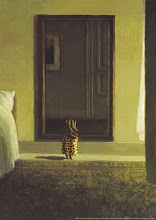
The "Brit a Day" series

What does a months-long parade of attractive British men have to do with fiction, you might well ask? These gentlemen have inspired some lovely scenes, part of the life I live in my head. Over time, some of these scenes reach out to one another and begin to form a story. For the present, each one of these pictures provides a writing prompt for me, a way to keep me writing with a sense of passion and narrative, even when the stories are not yet fully formed.


Tuesday, August 26, 2008

Church Cay, part 7


Part 7

At first I couldn’t understand why Frank would have his eye on me with someone like Dee around, but little by little I observed that men did not look at Dee the way I would have expected them to. She had something wrong with her back that caused her to limp. It didn’t seem to cause her much pain, but I could tell that she had altered all of her clothing to help hide the fact that one hip was a little higher than the other. In spite of her classically beautiful face and perfect hair, she must have looked like damaged goods to the men who came in the bar. I asked Frank once, didn’t he think Dee was beautiful, and he said he didn’t know. He said she was a good waitress, but it just hurt to look at her.

As for me, I tried not to think about the attention I got from the bar customers. The roadhouse had regulars, men and women, but it was so far from town that the majority of the patrons were one-timers, mostly men, truckers and such on their way to somewhere. If I wanted good tips I had to talk nice to them and dress in a manner that would give them a little hope, but hope was all they got. If Frank saw a customer looking at any part of me except my face, the white towel would get cranked down harder and faster into the glasses, and he would tell me to be careful. Under Frank’s watch, Dee and I never had much trouble. After closing and before he did the books each night, Frank would make sure that we got to our cars safely on our way home, in our opposite directions. Soon after that started, I started staying until Frank finished up, and soon after that, I started following him home in my car, but this time he knew I was driving right behind him. He invited me there. I walked in his bedroom. I saw my reflection on the inside of the window as my old self hiding outside, waiting to watch us make love for the first time, and I made Frank pull down the shades.

Thursday, August 21, 2008

Church Cay, part 6

Part 6

When I got older, on the other hand, I went to work after school hours in a roadhouse bar. I was sixteen, and I would never let my parents forget that I was born in a room over a bar. I came home late from the roadhouse smelling like smoke and beer, and no matter how quiet I was, my mother said that I always woke up the whole house with that smell. Nobody liked it, but I couldn’t help myself. I couldn’t sit in that house at night and listen to my father write his sermons.

The bar belonged to a twenty-seven-year-old guy named Frank, and Frank tended the bar. I knew from the first night I worked there that Frank had a passion for me. The first week I was there, he let me catch him making out his grocery list one night. The last item on the list was “grip.” I asked him what a grip was, and he said a grip was just one more thing he needed to get because he had lost his.

His hands were always moving and his knuckles were always cracked and red from washing glasses. I fell in love watching him dry glasses one night, three fingers twisting a white towel into the bottom of each glass. After work, I pretended to go home, but I went to his house and waited in the dark outside for him to come home from closing up. When he went inside and turned on the lights, I could guess where the bedroom was in the one-story house, and I waited outside the window to see him undress. I had never seen a naked man before, and I knew I loved him, so I thought it would be beautiful. But I remember now how I felt once he was naked as I stood and watched him walking around the room. His body was fine, but seeing him like that wasn’t beautiful, it was awful. I was so ashamed of myself, I had to hold myself with my arms to stop from shaking. As I tried to calm down, I just stood there and concentrated on his white shoulders, thinking I wasn’t so bad if I only looked at him from the waist up. Each muscle cast a faint shadow from the overhead light, and his chest was covered in light swirls of black hair that became so dense over his belly that it obscured his navel. His shoulders were perfectly bare and white, though. Down his arms were gradations of pinker skin, forearms slightly burned from the sun, hands red and chapped from the endless washing of glasses. I let my eyes follow the contour of his arm below his waist, and I was surprised at the appearance of his penis, redder than his hands, in its nest of black hair. There was nothing wrong with it, it just wasn’t what I had imagined. The only one I had seen before that was Jeff’s, and I hadn’t seen his since I stopped bathing him when he turned six.

I never told anyone that I had spied on Frank, not even Dee. Dee was the other waitress in the evenings in the bar. She was closer to Frank’s age, so she wasn’t someone that I could have known from school, but I felt like I had known her all my life. Dee was one of the most beautiful girls I had ever seen. One of her beauty secrets, she said, was to never sweat. She was much slower as a waitress than I was because she would stand for minutes at a time in front of the air conditioner if she felt a drop of perspiration coming on, her supple neck arching back and dry wisps of her long blonde hair streaming from her temples as though she were in freefall.

Thursday, August 7, 2008

Church Cay, parts 4 and 5


Part 4

After I was born, my father decided it was time to become a minister, and my parents waited in Baraterre for their first assignment from the Methodist Conference back home. It was a full eleven months before they were placed. Because my parents had come to the Exumas on their own, there was no income from the church, only what was left of their savings. They continued to rent the one-room flat over Fat Billy’s Ball ‘n’ Chain, and that alone is testament to their poverty, because my parents were teetotalers. We survived, ironically, through the grace of Billy, who passed on to us the condiments from the bar each night—a lot of nuts and citrus—and once a week, his brother would just happen to have caught a few extra fish, and the windfall became ours. My mother was never able to tell the story of our Christmas there without crying. Billy brought her a chicken, a precious commodity on Baraterre, on Christmas Eve, saying that his brother had accidentally run over it with his truck. When my mother showed skepticism about the wrapped carcass, Billy assured her that it was freshly dead and that the only trauma it had endured was from the wheel of the truck. My mother thanked him and took it, only realizing after he was gone and she unwrapped it that the headless chicken was otherwise whole. It could not have been hit by a truck and still be so deliciously intact, she knew. It must have been picked out and slaughtered especially for us.

When his assignment arrived, my father thought he was being sent to Colorado to minister to an Indian reservation, and that thrilled him. But since he couldn’t get his hands on any kind of map of the U.S. in Baraterre that was less than forty years old, he couldn’t be sure. There were no Indian reservations in eastern Colorado, though, just little towns like First View and Wild Horse that, if they were going to keep their faith alive in those days, depended on a Methodist circuit rider to drive from church to church preaching all day on Sundays.

He should have been happy, doing the Lord’s work among the already saved, but at the time he had no idea that the Conference was going to forget about us, that all four of us (I soon had a little brother, Jeffrey) would be staying there for the next sixteen years until we dried up like dead leaves, crazy enough to let that great spiraling tendency life has fling us apart.

Part 5

Eastern Colorado is flatter than Kansas. My brother Jeffrey, four years younger than me, seemed to be attracted to the immenseness of it from the day he was born. Whenever we took him outside in the daylight, you could see his little eyes, just barely able to focus, zeroing in on the farthest objects, sometimes the horizon itself. In the summers when it was hot, when he got a little older, we’d often find Jeff lying under the house with one side of his face pressed against the cool ground, staring out across the plain.

Jeff is an opera singer now, a tenor, one of the best in the world, and he is known for reaching into the back rows of the largest opera houses and pulling the hearts right out of the patrons’ chests with his voice. But I think he does it with his eyes. He learned to communicate with big empty spaces as a child.

To be continued…..

Sunday, August 3, 2008

Church Cay, part 3

Part 3

My parents shortly learned, while they mulled over their unusual situation from the relative civility of Baraterre, that the church, on its grand bluff, had been visible from half a dozen islands grouped in a curl away from the main archipelago. A hundred years ago, the Christianized inhabitants of those outer cays came to the church for their weddings, their baptisms, to bury their dead in its well-tended cemetery. But when the last missionary died, no one was sent to replace him. So for the ensuing generations, the outer islanders returned to the practice of burying their dead at sea. No one set foot in the church from that time on, but the sight of it across the water gave the disparate islanders a kinship, a common knowledge of something beyond their immediate existence.

My father was not a stupid man, but he was such an innocent one. He could not have failed to see from the geography of the islands and the gaping mouth of the trench just below where he stood that the cay was slowly pulling out from under him as it had pulled out from under the church. But my father would not be deterred from his mission. He did not know what the first church had looked like, nor could he tell much from the wreckage that lay at the bottom of the cliff. It had been down there so long that most of it had floated out to sea as driftwood, and what would not float had become a part of the bottom of the trench. There was no trace left of even a foundation, if one had ever existed.

So my father brought long boards and white paint on an armada of small boats from Baraterre to the island he christened Church Cay. The locals, some loving an eccentric, some fearing a zealot, helped him carry the rough goods and the hand tools to the top of the cliff, but none volunteered nor were they asked to stay and help him. He and my mother cleared out one of the homes to be their base camp, and it was my mother’s responsibility to catch and clean something each day to supplement the canned goods they had brought with them, but she returned to Baraterre when the advanced stage of her pregnancy made it impossible for her to climb out onto the rocks to fish at the shallow end of the island.

All alone, then, my father built a perfect scale replica of a white clapboard New England style church, steeple and all, achieving a height of twenty-three feet. Its exterior was flawless in proportion, but lacked a lot of detail, and the interior was, well, non-existent. The front door was a fake, nailed onto the outside, and the church was hollow, like a cardboard Christmas model for the mantel to be surrounded by angel hair snow.

Friday, August 1, 2008

Church Cay, part 2


Part 2

Just after their marriage, my mother and father went in search of a nameless cay in the Exuma archipelago where, they had heard, a few people lived who were badly in need of a sense of community, a connection to the Lord. At that time, and still today, none of the islands northwest of Great Exuma had a name except Baraterre which might as well be a part of Great Exuma it is so close. But the cays beyond it are spread out across the Atlantic like the bones of a great dissected spine and are not considered to be inhabited, but only because no one takes the time to see if they are. Descendants of the ‘Indians’ who lived throughout the Caribbean before the European migration swept most of them up as slaves or killed them with Old World diseases are still living in the Exumas, in some cases only one or two families to a cay, living their lives much as their ancestors did with the exception of two things. One is that the children are all gone. They have commuted to the present, transported off to the main island schools for a better education, and they have not come back home. The other is that those who stayed behind were all converted to Christianity. My father learned of this forgotten flock with their church crumbling into the surf from an obscure reference in National Geographic. He used the magazine as his atlas in seminary as he planned his life as a missionary, but unlike some of his classmates, he was not evangelical; he did not advocate proselytizing Christianity to other religions. So the idea of rebuilding the church on the cay was irresistible to him, serving a gathering of ready saved souls that needed a pulpit placed before it. He convinced my mother, a junior Bible college graduate, to marry him and join him on his crusade.


What they found when they got there was an island that had been abandoned long before the church had shrugged its shoulders and collapsed into the sea. The tiny cay was shaped like a melted slice of cheesecake, the graham cracker crust being a magnificent broad cliff a hundred feet high, the melted-down tip a shallow and treacherous point of submerged rocks. At the base of the cliff, the ocean opened up into a deep blue trench that looked like a bruise when viewed from the top of the ravine left by the landslide that had taken the church. Any boat that arrived at the island had to land midway between the two ends, necessitating a short precipitous climb to the habitable surface. Three small houses still stood in a crescent around the site of the church’s demise, but they were overrun with vegetation.

Thursday, July 31, 2008

Church Cay, part 1

Some men who came into Baraterre today tell me that the little church my father built decades ago has fallen off the edge of Church Cay into the sea. A church that had been there before it, built in the eighteenth century, did the same thing a long time ago. The news has started me thinking. We want so desperately to believe that our lives are uplifted lines, like pistons below our feet that we fight to balance on as we are sent soaring, always higher, out of the crude depths of our origins. But they aren’t. Each life is a spiral, a series of concentric revolutions that brings us within arm’s lengths of our past, again and again.

This is the story of my spiraling life, and I’ll try to be brief. Maybe you can make something out of it. My story, that is, up to this point.

I was born on an island in the Exuma chain in the Caribbean. My parents were white missionaries, southerners. I was born about as close to godlessness as I possibly could be, under the circumstances, above a bar in Baraterre called Fat Billy’s Ball ‘n’ Chain. My mother was living there above the bar in a rented room, but my father was on another island by himself building a church with no windows, no doors, and no prospect of a congregation. In other words, a house of God that not even God would set foot in, if he could find a way inside.

Thursday, July 24, 2008

In the moment, in the past

I had coffee with my friend Michele this morning. Neither of us grew up here in Southern California, but both of us feel that we are supposed to be here. I think we were talking about clothes when Michele said, "It's always summer here." It is, and, you know, it isn't. You have to really look, but you start to be able to discern the seasons here in ways mostly having to do with the angle of sunlight at noon. I find myself thinking, "In a month it will be twilight at this time of day, not mid-afternoon," and "Where did the middle of July go?"

I told her a little about some stuff that's going on at work, and then I came home and got reflective. My summers used to be defined by design deadlines, my busiest season, preparing to roll out new sets for tours each fall. I had to be super productive. In my own parallel universe, I had both of my babies in summer. Summer is what kids anticipate nine months out of the year.

What I have loved about summers, a visual list--the outer banks of North Carolina

Islay in Scotland


thinking about getting a dog


not gaining weight

reading slutty books or Nancy Drew

not reading Joyce


riding around with my uncle who knows all the good stories
getting the filter removed from my vena cava


the tour de France


reading about the festivals in NME in the aisles of Borders


designing sets for operas.

Thursday, July 3, 2008

We Are Scientists


Disclaimer to photograph: We Are Scientists did not lip synch, and the audience was not composed of dogs.

I went to the Casbah to see We Are Scientists last night. I'd seen them in 2006 at the House of Blues (which seems ridiculously large to me now). I much prefer a sold-out crowd in a small venue like the Casbah; that is, if I have tickets. Anyway, I have an aquaintance in the band that opened for them, The Blood Arm. So I really went to see them, and they were smashing. I went in believing that I only liked We Are Scientists, but I left the Casbah knowing I loved them.
I don't take video at shows, and even if I did, it wouldn't be very good. So I'm putting in this link to something more polished. The dog is gorgeous, and it's a great song, too.

Tuesday, July 1, 2008

Poor Sid, conclusion

Part 6

I slept for the remaining two hours that Diedre guided us in climate-controlled comfort through the countryside. We arrived at the first antique store, all a little groggy from the long car ride. My mother paused outside the car in the overbearing heat to powder her face with her little compact, while the humidity was already varnishing my hair to the sides of my face. But we returned to air conditioning as soon as we filed into the front of the store. Just inside the door, an item caught my eye, a heavy dark oak chair with a severe, straight back and thick arms. I touched it tenderly, like it was familiar to me, imagining it embellished with leather straps stained with years of nervous sweat, copper plates smeared with handprints, hand-tightened nuts and bolts. Aunt Cookie saw me and said, “I thought you’d like that. It’s a lot like that Mission style of furniture you saw so much of out in California, isn’t it?” I just smiled at her and nodded. She had no idea what she was talking about and even less what I was thinking.

I sat down in the chair and felt the leather straps tightening in swift jerks across my chest. In my own way, I’d killed a couple of people, too, avoiding eye contact with anyone who might have the smell of gas on his hands, or wear the scent of cheap musk cologne or the scent of my past. I thought of poor Sid, how for years until today I remembered him as nothing more than the stupidest kid in school, and how liberating it was to admit that by doing so, I had sort of helped the world to kill him. Back in high school, we were already examining the moist, hanging bits of bruised flesh of other people, trying to find someone else’s deformity, hopefully worse than our own.

Now Sid’s bones would be scraped clean, and he could simply be no one. A condemned man, once he is past his fear, most know that good feeling. I saw my aunt in the back of the store, talking to the owner, pointing my way and laughing. I heard her tell him about me in the chair, “Look, Wendell, I do believe she’ll take it.”

THE END

Saturday, June 28, 2008

Poor Sid, part 5

Part 5

When I woke up I was already walking inside of an old institutional building, a hall of doorways with transoms evenly spaced on both sides, and Diedre was at my side, pushing me along from the back of my arm. We were in a hallway adjacent to Death Row in the state penitentiary. I was surprised that no one was there to stop us, but Diedre’s momentum kept us moving right into one of the rooms. It was like a classroom in the oldest building at my high school, dirty green walls with darkly over-stained wood trim around everything from the dusty hardwood floors to the high water-stained ceiling. All that was missing was a chalkboard. “Diedre,” I said, “our moms?”

“Asleep,” she said. “Don’t worry. I left the AC on.”

Immediately inside the door I recognized the prison electric chair from what I’d seen on TV, but it was much smaller than I had envisioned. The cleaning people, all of them old and black, were in the process of taking it apart, producing things in their pink wrinkled palms for us to inspect. Some copper plates had been removed, and an old woman in a kerchief held one up to me. It was just a little bigger than her outstretched hand. I laid my hand on it, and where I made contact it was cool to the touch for just a moment before it reached body temperature. She held it silently, never looking into my face. The workers all seemed cowed by our presence, tentatively presenting the small parts in their calloused hands to Diedre and me before wiping them with rags and returning them to the chair. She took back the copper plate and wiped it free of my handprint, and before she laid it on the chair’s thick oak arm she showed me that it was clean. It was as though she and the others believed Diedre and I belonged there.

At the far end of the room, two skeletons were sitting upright on a church pew. Their postures were like riders waiting at a bus stop, aloof and unaware of one another. The skeletons weren’t as pristine as the one I’d seen in science class. Some flecks of flesh were still attached to the bones. As we moved farther into the room, the chair cleaners ignored us. Next to the church pew, a box was piled up with miscellaneous bones, disconnected ribs sitting on top, scraped clean of most of their tissue. I glanced around but did not see anyone scraping bones. Tucked between the box and the pew was a lone skull, one that looked more like an ape’s than a human’s, like the skull of a prehistoric man. I knelt down to it and saw something familiar about the shape of its empty eye sockets. This must be Sid, I thought. Cro-Magnon man, we used to call him. Waiting for his bones to be reassembled to make a skeleton like the others that had been seated on the pew.

So there had been three executions, I guessed, Tim, Sid, and some guy I didn’t know, and if I’d guessed right about the skull being Sid, then one of the two skeletons on the church pew must be Tim. Tim and Sid, neither particularly good students, were both going to spend eternity as props in some classroom.

Diedre was examining something that looked like an intact spine. The snake-shaped thing was in a box on a low square table and had the most flesh still attached to it of all the specimens lying around. The fresh tissue was pink and glistening, but it showed signs of severe trauma, red and purple splotches and scorches like a bruised gum. Diedre was leaning down so close to the spine that her shirt sleeve was brushing against it, becoming wet in the surrounding fluid. I was disgusted, almost crying. Clearly someone had died in agony only a short time ago. Diedre had a spinal birth defect, a deformed vertebra she once told me, that caused her chronic pain. She was probably examining the disembodied vertebrae with her own in mind, performing her own personal autopsy. It might not be Sid, I thought. It might be from the corpse of the guy I didn’t know about until we arrived in this room. The stranger seemed to exist to diminish my horror for the same reason that one gun in a firing squad is always loaded with blanks.

“Poor old Sid,” I said, tearing up, “poor old Sid,” just like I was eulogizing a beloved pet. He was a classmate, but he had never been my friend. Now he was dead and Tim was dead, too. Tim’s bones sat on that church pew just like he was ready to start shooting the shit with the stranger, looking right through me from the bench outside the school cafeteria, waiting for Kay Bradley to finish her lunch and come outside. His death already seemed old to me, and I accepted it because it was acceptable. But dear God, for some reason I just couldn’t get over poor Sid.

To be continued…

Tuesday, June 24, 2008

The spirit of summer, 1969


the Arctic Monkeys at Glastonbury, summer 2007

'Poor Sid' will return one day soon.

Vernon Reid, leader of the band Living Colour, was asked to provide commentary on 2 films that will be shown at the new visitors center at Bethel Woods, NY, the site of Woodstock in 1969. In speaking of the influence of that event on the future experiences of younger musicians, he articulates a philosophy that has become a religion for me: the need for openness of heart and mind to opportunities that exist in each moment. In other words, in my own spiritual terms, God=Opportunity. That’s all; recognizing the opportunities that lie in our path, often disguised as obstacles, is the same as recognizing this Being or Force or Spirit that is supposed to give cohesion to our lives.

I was only 9 the summer of Woodstock, and I think Vernon Reid was even younger, but he tapped into what became possible that summer when he said, “It was about being where you are, in the moment you’re in, and making things happen as much as you could in that moment. That’s something that’s not tied to any one time period; that’s a value. When my snare drum gets torn, when things go wrong, what do I do next? Woodstock, from beginning to end, was a series of things exactly like that—a production that ran on spirit, will and improvisational experience.”

Monday, June 23, 2008

Poor Sid, part 4


Part 4

I saw Tim one time when I was home from college, pumping gas into his rusty Buick at the StarFlite while I was sitting in the back seat of my father’s mint green Cadillac in my Sunday clothes. He had gray bags under his eyes, and the beginnings of a gut extruded over his belt beneath his T-shirt. He had puffed up like a rooster to become the overweight redneck his adolescent frame had foreshadowed, but his hair was still dirty black and straight to his shoulders. Our eyes met, and I slid away from the window to the hump over the transmission (which is pronounced even in a Cadillac) so that I made myself into an unapproachable princess stuck up there on the middle of the seat, not even acknowledging that I knew him.

Sid McCarthy was the other kid that was executed that night that I had known. I hadn’t seen him since High school, but I remembered Sid as The Dumb One, a big sweet blonde jock that everyone liked but thought was really stupid. Recently, I had to rack my brain to know how I’d ever had a class with someone as dumb as Sid, but then I remembered that Sid was surprisingly good at math and ended up in my calculus class senior year. He was sort of an idiot savant of derivatives.

Sunday, June 22, 2008

Poor Sid, parts 1-3


photo by Gregory Crewdson


A new short story, working title POOR SID

Part 1 (Deidre)

Deidre and I had taken turns driving our mothers on about half a dozen of these jaunts since I moved back from California. She was two years older than I was, so she didn’t pay much attention to me and my friends in high school. But I told her last night when we were planning this trip that I was a classmate of the two guys whose pictures had taken up half of yesterday’s front page. I confided to her that I was particularly uneasy about Timmy Reardon—I’d always felt pretty bad that I had snubbed a lot of people in those days when I decided I was going to California (never to return, of course), snubbed them on principle because they were still here, Deidre included, and I was ready to be anywhere but.

However, since I failed at what I went there to do, I came back to swallow my pride, and for the time being, live with my widowed mother.

Part 2 (Mom)

I shrugged at Deidre from the front porch where I had been holding the screen door open for about three minutes while my mother disputed something Aunt Cookie, Deidre’s mother, was saying in the kitchen.

Deidre was smart to be in the car. I was sure she already had the air conditioning on full blast because I saw dry wisps of blonde hair blowing straight back from her temples. The AC was so palpable that I almost smacked my lips in anticipation of it. When I stamped my foot impatiently, for Deidre’s benefit only, it was because I knew my mother would never be able to find her missing Cover Girl pressed-powder compact if she was preoccupied, so I prayed silently that Aunt Cookie would just shut up for a minute.

“You count your carbohydrates, not your calories,” Aunt Cookie said, explaining the diet for the second time.

“How do you lose weight if you don’t count calories?” My mother’s voice trailed from the kitchen to the hall, her eyes trained down to any surface where she might have left the compact.

Because you count your carbohydrates, Gracie,” Aunt Cookie insisted, as though my mother were missing the brain cells needed to understand her premise. Each time she repeated her new dieting mantra, her pitch rose and fell like the refrain from a nursery rhyme. Like jack and Jill went up the hill to count their carbohydrates. Like Humpty Dumpty fell off a wall, Humpty Dumpty counted them all.

Finally, my mother found her compact in her other purse, and they were out the door. We now had a two hour drive ahead of us through the flat Carolina piedmont to the old country road known as Antique Row. My sweet cousin Deidre smiled at me in the rear-view mirror, and I smiled back. I suddenly felt very tired. Deidre agreeably kept silent, and I sank down, wedging my head between the seat and the window so it wouldn’t do the dashboard-bobble-head-dog roll that it always did when I slept in cars or on the plane.

Part 3 (Timmy)

At two minutes after midnight the night before, the state electrocuted two men I’d known when I was younger. The two were executed for shooting a family in their station wagon—the mom, the dad, the three kids in the backseat—who happened to pull into the parking lot of the convenience store Tim and Sid had just robbed, momentarily blocking in the getaway car.

One of the men was Timmy Reardon. He had been a kind of thuggy kid that I once liked in that way that adolescent girls say they “like” someone. Tim wore his black hair long, and it separated into greasy strands where it broke against his shoulders. In seventh grade he wore zippered velour shirts that matched his Peter Max corduroy pants, a sure sign that his mother still picked out his clothes. He was my boyfriend for three glorious days that year until he found out my rival Kay Bradley had broken up with her beau. To this day, if I catch the scent of cheap musk cologne in a drug store, it reminds me of that moment with my face against Tim’s chest, the cologne making an odd caricature of the vestiges of baby fat that concealed his chest muscles, just before he walked away from me to Kay’s waiting arms across the school cafeteria. But Tim and I stayed friends, and that year at Christmas he gave me a tiny gold-plated cross on a delicate gold chain. He said that he’d asked his mother to help him pick it out. I wore it even though it turned my neck green, and eventually the little cross was completely encrusted with a pale husk of aquamarine brine.

To be continued…

Tuesday, June 17, 2008

To the Maid


“Thank you, Estrella,” I say to the maid as she hands me a fresh cup of coffee. “By the way, you did a marvelous job on the rug.” Her brown eyes tell me I’m welcome. I stroll through the dining room to the living room and stop momentarily at the faint ring of blood on the carpet where the baby was born two days ago into my hands before the paramedics arrived. My wife is here, just home from the hospital, holding the baby with my stepdaughter and my son from my first marriage looking on. Three years ago today I would have been standing here alone with my coffee, contemplating an empty couch, an empty room, a divorced man in his big new old house with the sparse furnishings his ex-wife would let him have. It is not a weekend; my son would not have been here on a weekday three years ago. He would have been in school.
Now there are five people here in this house who love me, if you count the baby, four in this room and Estrella, it has just dawned on me, in the kitchen. Should I say it out loud? “Three year ago I would have been standing in this room alone. Now there are four people here who love me, if you count the baby.” My wife smiles up at me from the couch and says, “Ummm.” My boy and the little girl take their eyes off the baby’s face for a moment, look at me, and wonder if I’m going to cry or say something else. The baby continues to breathe.
I’m standing in this room of perfect love. At this minute my family is poised before me like a snapshot of all my desires being fulfilled. I am struck by a vision of Estrella kneeling behind my wife and supporting her as the baby is pushed out into my trembling hands, Estrella’s smooth brown hand calmly stroking the side of my wife’s face. She is whispering a prayer in Spanish.
It will be another year before I sleep with the maid, and one of those times will be just inches away from the very stain the baby’s birth left on the carpet. When my wife finds out and I tell her it meant nothing she will say, “She is our maid, for God’s sake. You screwed her in the afternoon and three hours later you sat here and ate the meatloaf she made for dinner. How can you compartmentalize your life like that?” She will be pointing at the head of the table where we eat, but my eyes glide past her hand to the floor. I can’t answer her. By then I will have realized that desires are never fulfilled; they are only temporarily satiated.
In five years we will try to have another baby. My firstborn son will be married, and my wife will turn to me as we leave the church, the gleam of hope in her eyes utterly crushing me. During the ceremony she prayed to be pregnant, she will tell me. At that moment I will pray that Estrella, who is no longer our maid but still my lover, is not.
In ten years I’ll be diagnosed with inoperable cancer. Close to the end, I will tell my wife she and the children are going to be all right without me. My wife will cry, “No, I won’t. We were supposed to spend the rest of our lives together.”
“This is the rest of my life.”
But Estrella will tell me with her eyes the very last time we make love, “I will know you beyond the grave.”